“Riggs is a reporter who chose stone instead of newsprint.”
— contemporary reviewer, New York Herald Tribune, 1930s
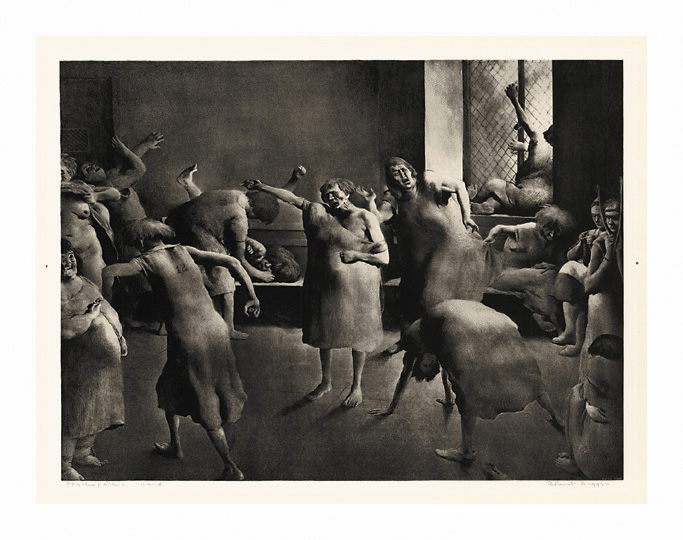
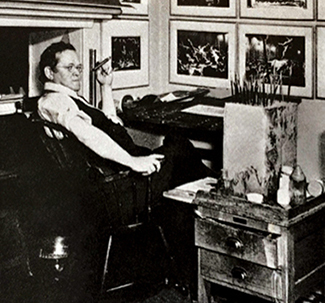
Robert Riggs was an American painter, printmaker, and illustrator whose work ranks among the most direct visual documents of American life between the wars. Best known for lithographs of boxing matches, circus performers, and hospital interiors, he combined journalistic observation with a disciplined graphic process to transform immediate experience into enduring, iconic imagery.
Riggs was born in Decatur, Illinois, and began his training at Millikin University before, at nineteen, winning a scholarship to the Art Students League in New York. He soon entered commercial practice, working for the advertising firm A. W. Ayer & Company in Philadelphia. During the First World War, he served in France with a Red Cross hospital unit, filling his sketchbooks with drawings of wounded soldiers and medical staff. The experience left a lasting imprint: the sober, unsentimental tone that later distinguished his hospital lithographs emerged directly from these encounters. While overseas, he also studied at the Académie Julian, joining the long tradition of American artists who balanced academic discipline with contemporary observation.
Returning to Philadelphia after the war, Riggs worked as a freelance illustrator and designer. In 1924, he traveled widely—North Africa, China, Thailand, and the Caribbean—producing watercolors that sharpened his powers of reportage and compositional economy. The decisive turn toward printmaking came in 1931 after seeing an exhibition of George Bellows’s lithographs. Bellows demonstrated that contemporary subjects—violent, crowded, and energetic—could be conveyed through the lithographic medium without losing immediacy or visceral connection. Riggs responded by producing his own boxing images, soon followed by a solo exhibition at the Frank Rehn Gallery in New York in 1933.
Between 1934 and 1936, the years of his greatest printmaking activity, Riggs produced the majority of the eighty-four prints that constitute his graphic oeuvre. The Depression-era audience, receptive to prints as an accessible form of original art, found in his work neither escapism nor overt protest but an attentive human record. He turned from prizefights to the circus, creating a series of fifteen lithographs that balance theatrical display with backstage fatigue—acrobats resting, performers waiting, the spectacle suspended between exertion and routine. Later, commissioned by the pharmaceutical firm Smith, Kline & French, he made a small but important group of hospital scenes, including operating rooms and wards, in which modern medicine is rendered with clarity rather than sentiment. These works connect directly to the observational discipline formed during the war: the figures are individualized yet restrained, their emotional force arising from posture, spacing, and refined detail.
Riggs’s graphic compositions are carefully constructed, guiding the eye through crowded interiors and complex interactions. The lithographic medium allowed him to move from velvety tonal passages to incisive contour, giving weight to atmosphere while preserving the authority of his drawing. The result is a realism of structure—observed life translated into ordered relationships rather than anecdotal narrative. His images of violence, performance, and convalescence share a single concern: the human body and spirit under strain, whether in combat, labor, or recovery.
Recognition followed steadily. Riggs was elected an associate of the National Academy of Design in 1939 and a full academician in 1946, the same year he received a solo exhibition at the Pennsylvania Academy of the Fine Arts. He gradually ceased printmaking around 1950 but continued producing black-and-white drawings for reproduction. From 1961 to 1963, he taught at the Philadelphia College of Art, influencing a younger generation through his insistence on drawing from life and an attentive focus on structural clarity. He spent his later years in New York, working continuously until his death in 1970.
Riggs occupies a distinctive place in American printmaking: he recorded contemporary experience with the detachment of an unflinching observer, the discipline of a skilled designer, and the resonance of a dedicated humanist. His lithographs preserve the immediacy of reportage while achieving a monumentalism grounded in refined detail and compositional order.
Works by Robert Riggs are held in the collections of the British Museum, London; Cornell University; Metropolitan Museum of Art, New York; Museum of Fine Arts, Boston; Museum of Modern Art, New York; National Gallery of Art, Washington, D.C.; National Library of Medicine; Philadelphia Museum of Art; Smithsonian American Art Museum; University of California, Santa Barbara; U.S. Library of Congress; Washington State University; Woodmere Art Museum; and the Yale Medical Library, among other institutions.