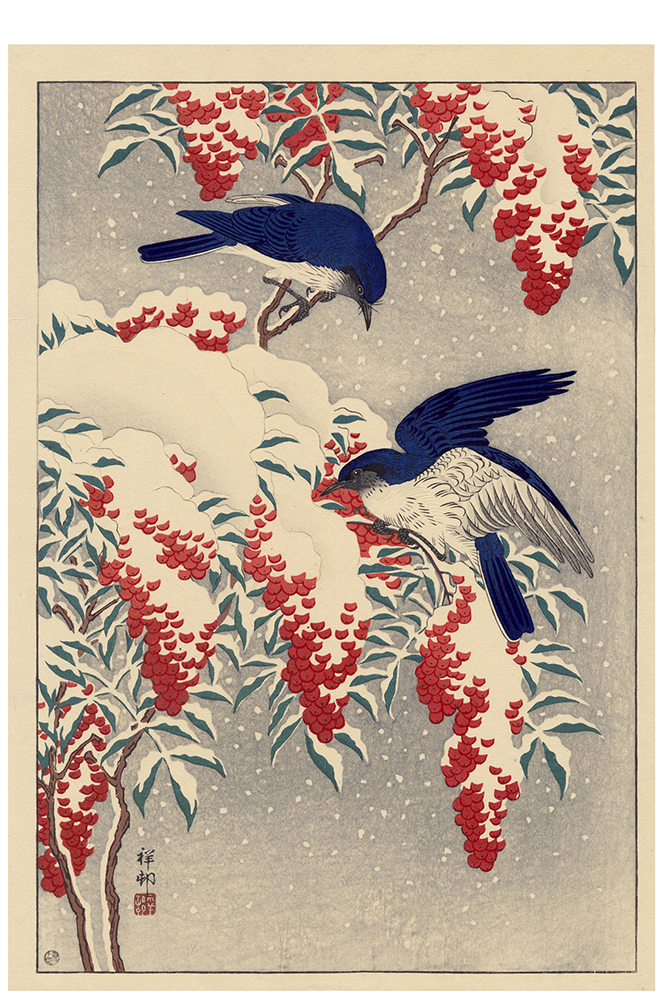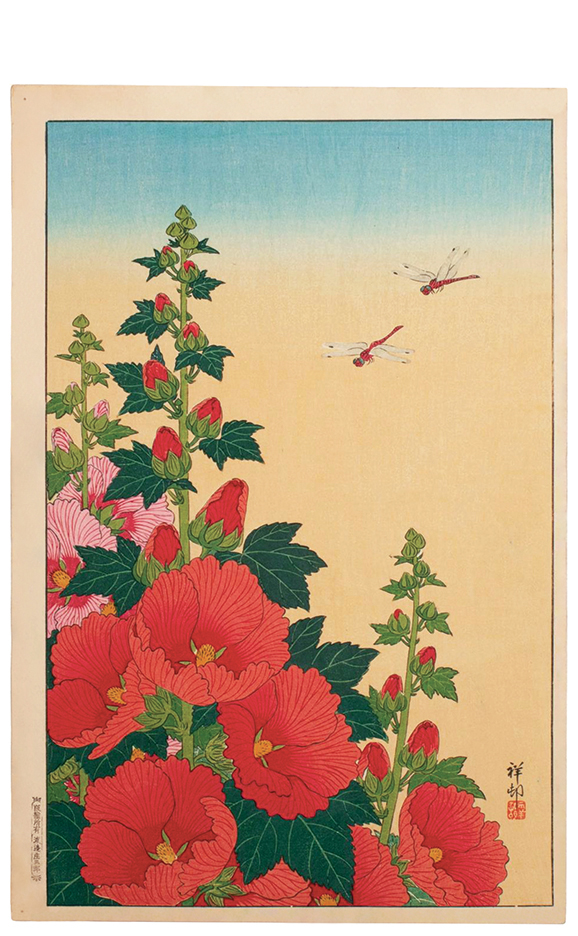
“Koson brought bird-and-flower imagery to a new level of poetic realism, balancing natural observation with an unmistakably modern sense of design.”
—Kendall H. Brown, Shin Hanga historian
“Koson’s kacho-ga achieve their power through understatement—subtle gradations of color, carefully cropped compositions, and an acute awareness of seasonal mood.”
—Andreas Marks, Japanese print scholar, author, and curator
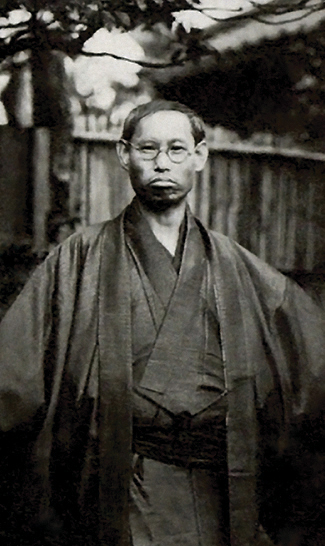
Koson Ohara (also known as Shoson and Hoson) is widely regarded as the most accomplished Japanese artist of early twentieth-century kacho-e (bird-and-flower pictures) woodblock printmaking. Through meticulous observation, refined draftsmanship, and a nuanced command of color, Koson revitalized the genre for a modern audience while remaining deeply rooted in classical Japanese pictorial traditions.
Born in Kanazawa as Matao Ohara, Koson began his training in painting under the Shijo-school master Kason, whose emphasis on naturalistic observation remained central to his work. Around the turn of the century, Koson relocated to Tokyo, where he became associated with the Tokyo art world and, during this period, encountered Ernest Fenollosa, the American scholar and collector whose advocacy of Japanese art proved instrumental in shaping Western appreciation of the genre. Around 1905, Koson turned decisively to woodblock print design. Fenollosa, then closely connected to the Museum of Fine Arts, Boston, encouraged the export of Koson’s bird-and-flower prints to American collectors, helping to establish his early international reputation.
Between roughly 1900 and 1912, Koson worked with several publishers, producing designs that included Russo-Japanese War subjects and landscape scenes, though his artistic focus remained firmly on kacho-e. His earliest and rarest prints from this period are distinguished by narrow vertical formats, restrained palettes, and a delicate atmospheric sensibility. These works were typically signed or sealed “Koson” and were most often published by Kokkeido and Daikokuya. After 1912, Koson adopted the name Shoson and largely withdrew from printmaking to concentrate on painting.
In the mid-1920s, Koson returned to woodblock print design, entering into a highly productive collaboration with the Shin Hanga publisher Shozaburo Watanabe beginning in 1926. Around 1930, when working with the publishers Sakai and Kawaguchi, he adopted the name Hoson. These later prints represent the culmination of his mature style, combining technical precision with a heightened sense of atmosphere and compositional clarity. During this period, Koson also served in an advisory capacity to Japan’s National Museum of Modern Art.
Koson’s prints are held in major museum collections worldwide, including the British Museum, the Brooklyn Museum, the Freer Gallery of Art, the Harvard Art Museums, the Los Angeles County Museum of Art, the Museum of Fine Arts, Boston, and the Metropolitan Museum of Art.