T h é o d o r e = G é r i c a u l t - - 1 7 9 1 - 1 8 2 1


Modernist Abstration,


“Géricault was one of those rare artists who changed the course of art not by refinement, but by force.”
— Charles Clément, Géricault: Étude biographique et critique, 1868

“He brought into art a new sincerity—violent, uncompromising, and profoundly modern.”
— Jules Michelet, 19th-century art criticism


Théodore Géricault (1791–1824) occupies a pivotal position in early nineteenth-century French art as a founding figure of Romanticism whose work bridged the traditions of narrative painting and the emerging demands of modern realism. His short, intense career was marked by courageous authenticity, emotional commitment, and a refusal to accept the prevailing conventions of artistic propriety.

Although Géricault received about three years of formal studio training—most notably with Carle Vernet and Pierre-Narcisse Guérin—he was largely self-directed. He copied Old Master paintings extensively in the Louvre and undertook formative travel to Italy, where encounters with Michelangelo’s sculpture and the dynamism of Baroque art profoundly shaped his understanding of anatomy, movement, and expressive scale. These experiences fostered an art grounded in physical intensity and psychological immediacy.

Géricault’s art is defined by its synthesis of Romantic drama with relentless observation from life. This fusion reached its apex in The Raft of the Medusa (1818–19, Louvre), a monumental painting that transformed a contemporary political scandal—a shipwreck attributed to governmental negligence—into a modern narrative painting of unprecedented realism and emotional power. In preparation, Géricault constructed a scale model of the raft, conducted anatomical studies of severed limbs and cadavers, and enlisted friends, including Eugène Delacroix, as models. The resulting work shocked audiences with its unidealized bodies, moral ambiguity, and direct engagement with current events, securing Géricault’s reputation while provoking intense controversy.

Géricault was a master of lithography, the only printmaking medium he employed. His lithographs, devoted primarily to horses and military subjects—lifelong passions—demonstrate the same immediacy and structural power found in his paintings. During his English sojourn of 1820–21, he deepened his technical understanding of lithography in the London workshop of Charles Joseph Hullmandel. The most significant outcome was the series Various Subjects Drawn from Life and on Stone (often called The English Set), a group of twelve lithographs notable for their fluid draftsmanship and dramatically composed realism. After returning to France, he continued his equine studies in the celebrated series Études de chevaux lithographiés (Studies of Horses in Lithography), which remain among the most accomplished lithographs of the Romantic period.

Géricault’s life was cut short at the age of thirty-two, following a prolonged illness resulting from a riding accident. His final major works—intimate portraits of the mentally ill, discovered decades after his death—extended his challenge to artistic convention by presenting marginalized subjects with dignity, gravity, and psychological depth. Like The Raft of the Medusa, these works redefined the boundaries of serious art and anticipated later developments in realist and modernist practice.

Géricault’s lithographs and works on paper are held in major public collections worldwide, including the Alte Pinakothek, Munich; Art Institute of Chicago; British Museum; Getty Museum; Hermitage Museum; Kunsthalle Hamburg; Louvre Museum; Metropolitan Museum of Art; Morgan Library & Museum; Musée des Beaux-Arts de Lyon; Musée Fabre; Musée Royal des Beaux-Arts de Belgique; National Gallery of Art; and the Museum of Fine Arts, Boston.
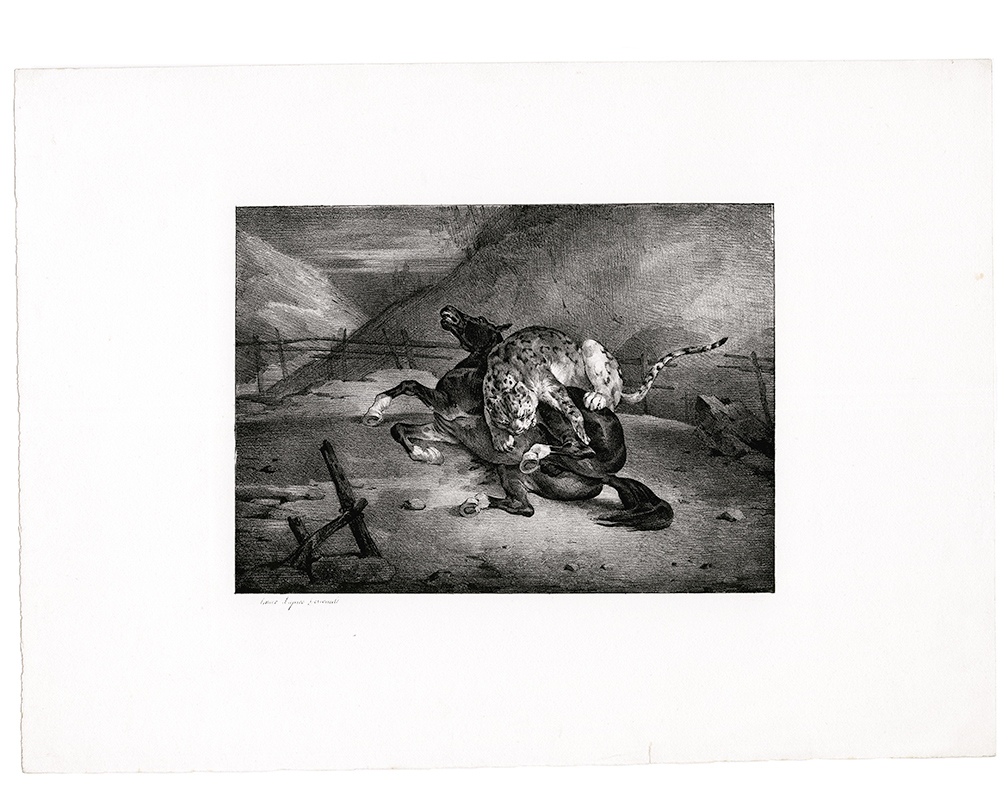


Tigre dévorant un cheval (Tiger Devouring a Horse)- - c. 1820, Lithograph.

Edition unknown, 3rd state of 3. Clement 97. Signed Volmar d'après Géricault, lower left. Rendering by Joseph Simon Volmar.

Image size 6 1/4 x 8 11/16 inches (159 x 221 mm); sheet size 11 3/8 x 15 3/4 inches (289 x 400 mm).

A fine, richly-inked impression, on off-white wove paper, with wide margins (2 1/4 to 3 1/2 inches), in very good condition.

$500.


Le maréchal flamand (The Flemish Blacksmith) from the suite Études de Chevaux - - 1822, Lithograph.

Edition unknown, 2nd state of 2. Delteil 85. Lettered: Géricault del. Chez Gihaut, éditeur, Md d'Estampes, b.ard des Italiens No 5. According to Delteil, the lithograph was completed in large part by Leon Cogniet. Published by Gihaut Frères, Paris.

Image size 9 5/8 x 12 3/4 inches (245 x 324 mm); sheet size 15 1/4 x 21 1/8 inches (387 x 537 mm).

A fine, richly-inked impression, on off-white wove paper, with wide margins (2 1/2 to 4 1/2 inches), in excellent condition.

Collections: Art Gallery NSW, Art Institute of Chicago, British Museum, Harvard Art Museums, Metropolitan Museum of Art, National Gallery of Art, Princeton University Art Museum, RISD Museum, Virginia Museum of Fine Arts, Yale University Art Gallery.

$1400.


Garcon donnant l'avoine à un cheval dételé (Boy Giving Oats to a Hitched Horse)-un1822, Lithograph.

Edition unknown, 2nd state of 2. Delteil 89. Lettered: Géricault del, chez Gihaut Editeur. Md. d'Estampes, bard. des Italiens, N 5. According to Delteil, the rendering is by Joseph Simon Volmar. Printed by François de Villain. Published by Gihaut Frères, Paris.

Image size 16 7/16 x 13 1/16 inches (418 x 332 mm); sheet size 20 1/4 x 15 1/8 inches (527 x 384 mm).

A fine, richly-inked impression, on off-white wove paper, with margins (7/8 to 1 7/8 inches) in very good condition.

Collections: Blanton Museum of Art, British Museum, Five Colleges and Historic Deerfield Museum Consortium, High Museum of Art, McMaster Museum of Art, Museum of Fine Arts, Boston; Toledo Museum of Art.

$1100.


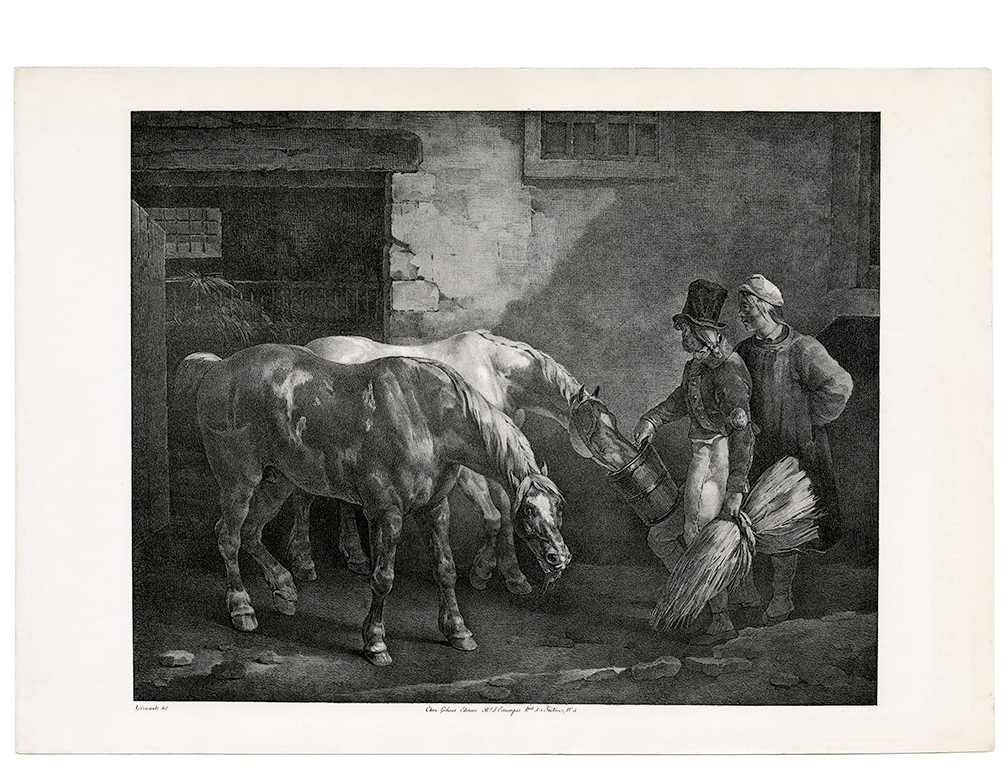
Deux chevaux de poste à la porte d'une écurie (Two Post Horses at the Door of a Stable)-un1822, Lithograph.

Edition unknown, 2nd state of 2. Delteil 88. Lettered: Géricault del, chez Gihaut Editeur. Md. d'Estampes, bard. des Italiens, N 5. According to Delteil, the rendering is by Joseph Simon Volmar. Printed by François de Villain. Published by Gihaut Frères, Paris.

Image size 13 1/2 x 17 1/8 inches (343 x 435 mm); sheet size 15 3/4 x 22 3/8 inches (400 x 568 mm).

A fine, richly-inked impression, on off-white wove paper, with margins (1 to 2 5/8 inches), in very good condition.

Collections: Ackland Museum, British Museum, Fitzwilliam Museum (Cambridge), Metropolitan Museum of Art, Musée des Beaux-Arts (Rouen), Musée d’Orsay (Paris), Musée du Louvre, Yale University Art Gallery.

$1100.


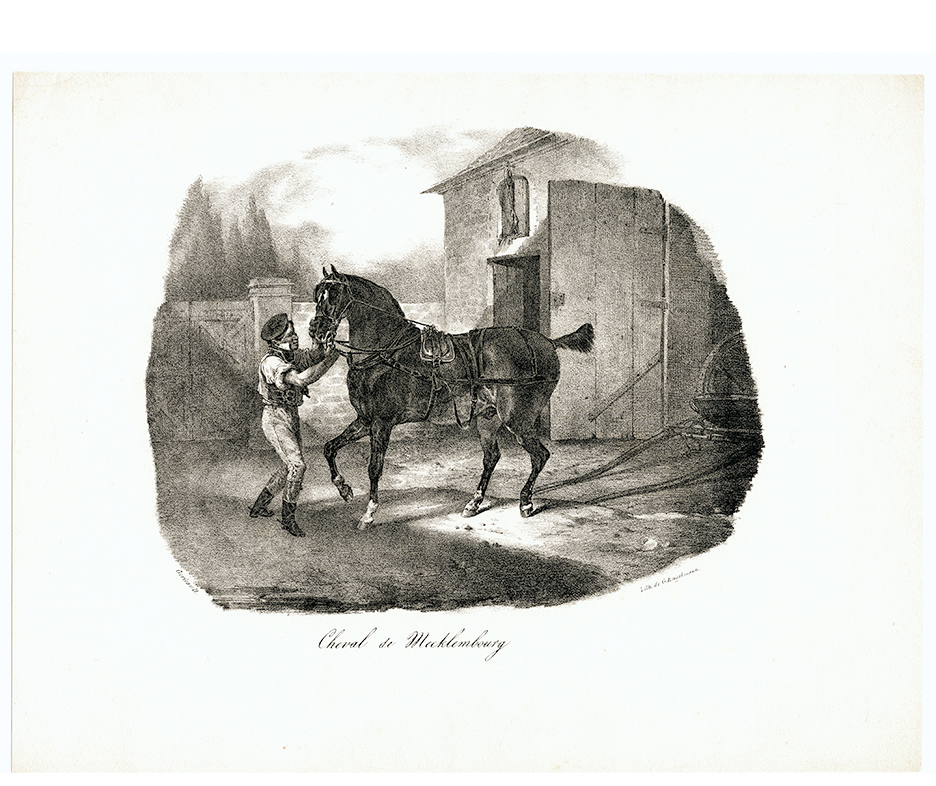
Cheval de Mecklembourg (Mecklembourg Horse)-un1822, Lithograph.

Edition unknown, 2nd state of 4. Delteil 47. Signed Gericault, lower left. Published by Godefroy Engelmann I.

Image size 7 3/8 x 9 1/4 inches (187 x 235 mm); sheet size 10 5/8 x 13 3/4 inches (270 x 333 mm).

A fine impression, on off-white wove paper, with margins (7/8 to 2 3/8 inches), in good condition.

Collections: Bibliothèque de l’Ecole des Beaux-Arts, Paris; British Museum; Cabinet des Estampes, Paris; Metropolitan Museum of Art; Minneapolis Institute of Art; Musée de Rouen; National Gallery of Art; Philadelphia Museum of Art; Rhode Island School of Design Museum; University of Cambridge Museum; Virginia Museum of Fine Arts; Yale University Art Gallery.

$450.


Roulier montant une côte (A Cart Driver and a Postilion on a Hillside) from the series Quatre (Cinq) Sujets Divers (Four (Five) Diverse Subjects)(-un 1823, Lithograph.

Edition unknown, 5th state of 5. Delteil 76. Signed Géricault, lower right. Numbered No 15, upper right. Printed by Godefroy Engelmann I; published by Mme Hulin, Paris.

From a series of five lithographs published in Paris in 1823 by Mme Hulin, rue de la Paix no.21. According to Delteil, the series was originally intended to comprise four prints, as indicated by the series title which is printed on the front cover (reproduced in the catalogue).

Image size8 13/16 x12 1/8 inches (223 x 307 mm); sheet size 11 1/4 x 15 3/4 inches (286 x 400 mm).

A fine impression on off-white wove paper, with wide margins (1 1/8 to 1 7/8 inches), in very good condition.

Collections: Art Institute of Chicago, British Museum, Metropolitan Museum of Art, National Gallery of Art, RISD Museum, University of North Dakota, Virginia Museum of Fine Arts.

$600.


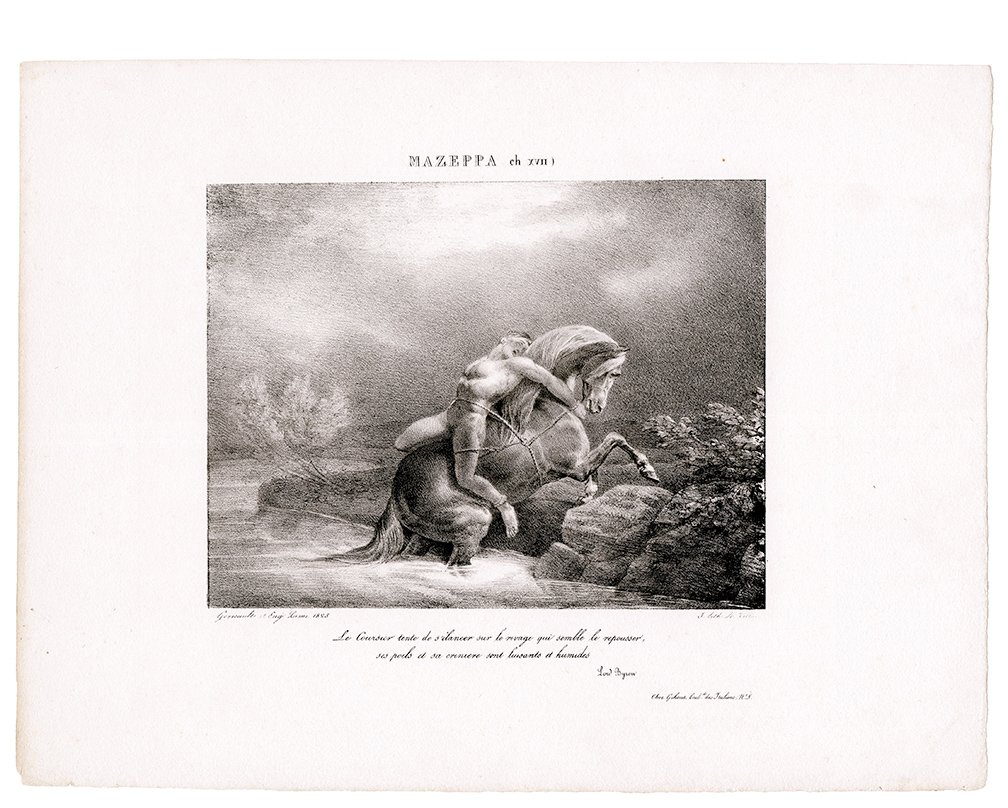
Mazeppa from the series Oeuvres de Lord Byron-un1823, Lithograph.

Edition unknown, 2nd state of 3. Delteil 94. Lettered Gericault, & Eug. Lami 1823; and Litho de Villain, with the title lettering MAZEPPA (ch. XVII); Chez Gihaut Boul.d des Italiens No 5; and the line from Lord Byron's poem: Le Coursier tente de s'élancer sur le rivage qui semble le repousser, ses poils, et sa crinière sont lissants et humides... (Lord Byron). Rendered by Théodore Géricault and Eugène Lami; printed by François de Villain; published by Gihaut Frères.

According to Delteil, the print is part of a series of six lithographs intended to illustrate the works of Lord Byron and published in 1823. Four of them were produced in collaboration with Eugène Lami, the remaining two solely by Eugène Lami.

Image size 6 1/4 x 8 3/16 inches (159 x 208 mm); sheet size 10 3/4 x 14 1/4 inches (273 x 362 mm).

A fine impression on off-white wove paper, with wide margins (1 3/4 to 3 1/4 inches), in very good condition.

Collections: Bibliothèque nationale de France, British Museum, Metropolitan Museum of Art, Virginia Museum of Fine Arts.

$750.


Intérieur d'écurie voûtée (Interior of a Vaulted Stable)-un c.1823, Lithograph.

Edition unknown, 3rd state of 3. Clement 98. Lettered Volmar d'après Géricault and chez Gihaut bard. des Italiens, N5. Printed by François de Villain; published by Gihaut Frères.

According to Delteil, the lithograph was executed to a great extent by Joseph Simon Volmar.

Image size 8 1/16 x 11 inches (205 x 279 mm); sheet size 11 1/4 x 15 3/4 inches (286 x 400 mm).

A fine impression on off-white wove paper, with wide margins (1 5/8 to 2 3/8 inches), in very good condition.

Collection: Yale University Art Gallery.

$500.


Home