H o w a r d - C o o k - - 1 9 0 1 - 1 9 8 0


Modernist Abstration,

 
"This matter of style, of course, is not for me to speak of. ...I have never been content to limit myself in any way, either in medium, in interpretation or conception of subject matter. ...I have always determined to step out vigorously with my own thoughts and my own way of saying things to make my most vigorous comment on what I considered the valuable elements of contemporary living."
—Howard Cook, from The Graphic Work of Howard Cook, A Catalogue Raisonné, The Bethesda Art Gallery, Inc., 1984.

"Howard Cook's superb legacy of American images continues to hold the same power to move and impress. Created with honesty, vigor, and freshness of vision, his works are assured an enduring place in the history of American prints."
—Janet A. Flint, from The Graphic Work of Howard Cook, A Catalogue Raisonné, The Bethesda Art Gallery, Inc., 1984.


Howard Cook was among the most accomplished American printmakers of the interwar period and a major figure in New Deal–era mural painting. His wood engravings and lithographs—particularly those depicting urban infrastructure—are noted for their structural clarity, tonal power, and architectural rigor, while his later fresco cycles rank among the most ambitious public artworks produced in the United States during the 1930s.

Cook was born in Springfield, Massachusetts, and studied at the Art Students League in New York, where he learned printmaking under Joseph Pennell. Early employment in lithography and photo-engraving shops gave him an unusually strong technical foundation and an appreciation for the direct visual impact of printed tone. By the late 1920s, he was producing wood engravings that transformed bridges, skyscrapers, and construction sites into dynamically structured compositions, often compared to Precisionism for their clarity but distinguished by a tactile, printmaker’s engagement with surface and contrast.

His early success was quickly recognized. Cook’s first one-man exhibition of prints was held at the Denver Museum of Art in 1927, followed by exhibitions at the Weyhe Gallery in New York, where Carl Zigrosser became an important advocate. A one-person exhibition at Weyhe in 1929 firmly established his reputation within New York’s print world. During this period, Cook also studied lithography in Paris, including work at the Desjobert atelier, broadening his technical range and reinforcing his commitment to printmaking as an expressive medium.

Two Guggenheim Fellowships proved decisive in shaping Cook’s artistic trajectory. The first, awarded in 1932, supported an extended stay in Taxco, Mexico, where he produced prints attentive to everyday life and began studying fresco technique. Works from this period earned significant recognition, including the John Taylor Arms Prize from the Society of American Etchers and an honorable mention from the Philadelphia Print Club. A second Guggenheim Fellowship in 1934 enabled Cook to travel extensively through the American South, deliberately seeking direct contact with regional life and labor. That journey produced a substantial body of drawings and prints and provided the conceptual foundation for the large-scale mural work that soon followed.

By the mid-1930s, Cook had turned increasingly toward public art. Under the Treasury Section of Fine Arts, he completed major fresco commissions, culminating in the monumental mural cycle for the San Antonio Post Office and Courthouse (completed in 1939), one of the largest New Deal mural projects executed by a single artist. Although mural painting became central to his practice, Cook continued to draw and make prints, maintaining a consistent graphic sensibility across media.

During World War II, Cook served as an artist-correspondent in the Pacific theater, producing drawings and prints that reflect the immediacy and psychological intensity of firsthand observation. After the war, his work was reassessed in exhibitions such as the 1946 retrospective Exhibit of Prints and Recent War Drawings at the Dallas Museum of Fine Arts. Later exhibitions, including shows at the New Mexico Museum of Art (1979) and Howard Cook: Drawings of Alabama at the Mobile Museum of Art (2007), have further clarified the continuity of his vision across decades.

Within the broader narrative of American art, Cook occupies a distinctive position linking Precisionist-influenced printmaking, documentary engagement with the American scene, and the ambitions of federally sponsored muralism. His work resists both sentimentality and abstraction for its own sake, favoring instead a disciplined realism shaped by structure, experience, and place.

Today, Cook’s prints are increasingly valued for their technical authority and historical insight, while his murals remain touchstones of New Deal public art. Together, they secure his reputation as an artist who moved fluently between intimate and monumental forms without compromising clarity or integrity.

Works by Howard Cook are held in the collections of the British Museum, Harvard Art Museums, the Metropolitan Museum of Art, the Minneapolis Institute of Art, the Museum of Modern Art, the National Gallery of Art, the Smithsonian American Art Museum, and the Whitney Museum of American Art, among many others.


Chrysler Building (Chrysler Building in Construction) - -1930, Wood Engraving.

Duffy 122. Edition 75, only 50 printed. Signed, dated and annotated imp in pencil. Titled Chrysler Bldg. in the bottom left margin.

Image size 10 1/16 x 6 11/16 inches (256 x 170 mm); sheet size 11 7/8 x 9 inches (302 x 229 mm).

A superb, richly-inked impression, on thin, cream wove Japan paper, with full margins (1 1/4 to 5/8 inches), in excellent condition. Printed by the artist.

Chrysler Building is among the artist's most well-known precisionist works. Cook's compelling composition emphasizes the monumental, sculptural presence of the Chrysler Building by framing it with the surrounding smaller buildings—the angular geometry and stark contrasts of light and dark convey the dynamism of the emerging New York City skyline. At the time Cook created this work, before the completion of the building's now famous art deco crown, the structure was the world's tallest building, holding the title for 11 months until it was surpassed by the Empire State Building in 1931. The Chrysler Building still ranks as the tallest brick building in the world (though the internal skeleton is steel), and remains New York City's most famous Art Deco landmark.

Collections: Cornell University Library, Baltimore Museum of Art, Boston Public Library, Cleveland Museum of Art, Herbert F. Johnson Museum of Art, Cornell; Hood Museum of Art, Metropolitan Museum of Art, Museum of Fine Arts Boston, New Mexico Museum of Art, Museum of Modern Art, Smithsonian American Art Museum, New York Public Library.

$16,000.


Edison Plant- 1930, Lithograph.

Duffy 127. Edition 75, only 35 printed. Signed and dated in penci. Titled in the artist's hand, bottom left sheet edge.

Image size 13 3/8 x 9 7/8 inches; 340 x 251 mm; sheet size 22 3/4 x 15 7/8 inches; 578 x 403 mm.

A superb, richly-inked impression, on cream wove paper; the full sheet with wide margins (2 3/4 to 3 1/2 inches). Pale light toning and gentle rippling at the sheet edges, in original, excellent condition.

Provenance: Descended through the family of the artist to his sister and subsequently to his niece.

Exhibition/Literature: L’Amérique de la Dépression: Artistes Engagés des Années 30, Musée-Gallerie de la Seita, Paris, 1996.

Featured with a full-page reproduction in the catalogue raisonnée of the artist's graphic oeuvre The Graphic Work of Howard Cook, Betty and Douglas Duffy, Bethesda Art Gallery, 1984.

Collections: Amon Carter Museum of American Art, Bowdoin College Museum of Art, Crystal Bridges Museum of American, National Gallery of Art, Philadelphia Museum of Art, Smithsonian American Art Museum, University of New Mexico (Tama Institute).

SOLD

Urban Industrial, Edison Plant, New York City, Modernisn, Abstraction

Engine Room - 1930, Lithograph.

Duffy 128. Edition 75, only 35 printed. Signed, dated, and editioned 75 in pencil.

Image size 10 1/8 x 12 1/4 inches (257 x 311 mm); sheet size 13 1/2 x 15 5/8 inches (318 x 397 mm).

A fine, rich impression, on cream wove paper, with wide margins (1 to 2 1/2 inches), in excellent condition.

This work depicts the engine room of the S.S. Exhibitor, a freighter on which the Cooks sailed to Africa and Europe in 1929.

Literature: Graphic Excursions, American Prints in Bkack and White, 1900-1950, Godine,1991.

Collections: Cornell University Library, Crystal Bridges Museum of American Art, Metropolitan Museum of Art, Smithsonian American Art Museum, Philadelphia Museum of Art, Whitney Museum of American Art.

SOLD


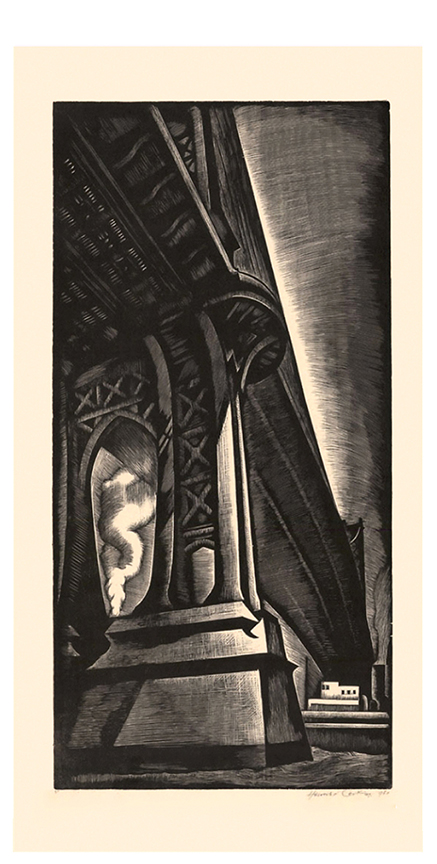
Manhattan Bridge - 1930, Woodcut.

Duffy 134. Edition 50 (40 printed). Signed and numbered 17/50 in pencil. Titled in the artist’s hand on the bottom left sheet edge.

Image size 17 1/2 x 8 5/8 inches (445 x 219 mm); sheet size 20 3/4 x 10 1/2 (527x 267 mm).

A superb, richly-inked impression on cream wove paper, with margins (7/8 to 1 3/4 inches), in excellent condition.

Literature and Exhibitions: American Prints 1900 – 1950, Yale University Art Gallery, May 10 – August 31,1983. A Century on Paper: Prints by Art Students League Artists 1901-2001, UBS Paine Weber Art Gallery, New York, 2002.

Selected for Fifty Prints of the Year, American Institute of Graphic Arts, New York,1929.

Featured with a full-page reproduction in the catalogue raisonnée of the artist's graphic oeuvre The Graphic Work of Howard Cook, Betty and Douglas Duffy, Bethesda Art Gallery, 1984.

Collections: Detroit Institute of Arts, Fordham University Libraries (President’s Print Collection), Smithsonian American Art Museum, National Gallery of Art, Philadelphia Museum of Art, New Mexico Museum of Art, Yale University Art Gallery.

$8500.

Brooklyn Bridge, Iconic Modernism, Cubism, Constructivism

Financial District - 1931, Lithograph.

Duffy 155. Edition 75. Signed, dated and editioned 75 in pencil.

Image size 13 5/16 x 10 3/8 inches (338 x 264 mm); sheet size 23 x 16 inches (584 x 406 mm).

A fine, richly-inked impression, on cream wove paper, the full sheet with wide margins (2 3/4 to 5 5/8 inches), in excellent condition.

Literature: American Master Prints from the Betty and Douglas Duffy Collection, the Trust for Museum Exhibitions, Washington, D.C., 1987.

"Financial District is not only a remarkable study in form and composition but also reveals Cook's now considerable command of lithography. With its beautifully articulated nuances of soft, silvery grays and blacks, this print suggest a more lyrical New York, its angular edges and contours briefly softened by waning light or atmospheric haze."
—Janet A. Flint, from The Graphic Work of Howard Cook, A Catalogue Raisonné, The Bethesda Art Gallery, Inc., 1984.

Featured with a full-page reproduction in the catalogue raisonnée of the artist's graphic oeuvre The Graphic Work of Howard Cook, Betty and Douglas Duffy, Bethesda Art Gallery, 1984.

Collections: Crystal Bridges Museum of American Art, Library of Congress, Metropolitan Museum of Art, Princeton University Art Museum, Philadelphia Museum of Art, Smithsonian American Art Museum.

$12,000.


Montparnasse Street- 1931, Etching.

Duffy 128. Edition 50, only 25 printed. Signed, dated, and annotated imp and 50 in pencil.

Image size 4 7/8 x 9 7/8 inches (124 x 251 mm); sheet size 7 1/2 x 13 1/2 inches (191 x 343 mm).

A fine, richly-inked impression, on cream laid paper, with full margins (1 1/4 to 1 7/8 inch), in excellent condition. Printed by the artist. Scarce.

Collections: National Museum of American Art, Philadelphia Museum of Art, Smithsonian American Art Museum, University of New Mexico.

$3000.

Paris, Men, Nocturne, Night Scene

Soaring New York- 1931-32, Aquatint, Soft-ground Etching, Roulette.

Duffy 165. Edition 25. Signed, dated, and annotated imp in pencil.

Image size 8 15/16 x 11 13/16 inches (227 x 300 mm); sheet size 113/8 x 15 1/4 inches (289 x 387 mm). Scarce.

A superb, atmospheric impression, in warm black ink on cream wove paper, with full margins (1 1/4 to 1 3/4 inches, deckle all around), in excellent condition. Printed by the artist. Scarce.

The artist uses three different intaglio techniques in this work to capture the gritty energy of New York City's monumental skyline. The view is looking South from midtown, with the Empire State Building in the center background and the Chrysler building on the left.

Collections: Dallas Museum of Art, Georgetown University Library, National Museum of American Art, Smithsonian American Art Museum, University of New Mexico.

$15,500.

New York City skyscrapers

Taxco Market- 1932-33, Aquatint, Etching.

Duffy 181. Edition 30. Signed and titled in pencil. Numbered 50 in the bottom right sheet corner.

Image size 8 7/8 x 11 7/8 inches (225 x 302 mm); sheet size 12 x 16 1/8 inches (305 x 410 mm).

A superb, richly-inked impression, on cream wove paper; the full sheet with margins (3/4 to 1 inch). Mild tape stains across the top sheet edge (7/16 inch) away from the image; spot stain in the upper left margin, away from the image; otherwise in good condition. Printed by the artist.

Awarded the Logan Medal, International Exhibition of Etching and Engraving, Art Institute of Chicago, 1935.

Exhibition: Impressions: Prints of Mexico, 1930s-40s / Impresiones: Estampas de México, 1930s-40s, Zimmerli Art Museum, 2018.

Collections: Art Institute of Chicago, Library of Congress, McNay Art Museum, Museum of Modern Art, New York Public Library, Philadelphia Museum of Art, Smithsonian American Art Museum.

SOLD

New York City skyscrapers

Looking Up Broadway- 1937, Lithograph.

Duffy 192. Edition not stated. Signed and dated in the stone, lower left.

Image size13 x 9 7/16 inches (330 x 240 mm); sheet size 19 3/16 x 12 5/8 inches (487 x 321 mm).

A fine, richly-inked impression, with wide to full margins (1 3/8 to 3 inches), on heavy cream wove paper. Pale tape stains on the sheet center, verso (not showing recto), otherwise in excellent condition.

Published by American Artists Group, New York, in an unsigned, unnumbered edition. Typically the AAG editions were c. 200 but the scarcity of this work suggests that the published edition was smaller, or that few impressions have survived.

Collections: Achenbach Foundation for Graphic Art, de Young I Fine Arts Museums of San Francisco, Metropolitan Museum of Art, Philadelphia Museum of Art.

$4000.


Eagle Dance - -1942, Wood Engraving.

Duffy 201. Edition 200. Signed and dated in pencil.

Image size 10 x 8 inches (254 x 203 mm); sheet size 14 7/8 x 12 1/4 inches (378 x 311 mm).

A superb, black impression, on off-white wove paper, with full margins (2 to 3 7/8 inches), in excellent condition.

An impression from the edition published for the Twenty-first Presentation Print of the Woodcut Society, 1942. Printed by Torch Press, Cedar Rapids. Complete in the original Woodcut Society letterpress presentation folder.

Collections: Achenbach Foundation for Graphic Art, Cleveland Museum of Art, Library of Congress, Museum of Fine Arts, Boston, National Museum of American Art, New York Public Library, Roswell Museum, Springfield Museum of Fine Arts, University of New Mexico, Yale University Art Gallery.

SOLD


Brooklyn Bridge- 1949, Lithograph.

Duffy 214. Edition 20. Signed, dated and annotated Thanks, George! in pencil. Titled Brooklyn Bridge in pencil, bottom left margin. The annotation suggests that this impression was probably gifted by the artist to his printer, master lithographer George C. Miller.

Image size 10 1/16 x 6 11/16 inches (256 x 170 mm); sheet size 11 7/8 x 9 inches (302 x 229 mm).

A fine, richly-inked impression, on cream wove paper, with full margins (2 1/8 to 7/8 inches), in excellent condition. Scarce.

Featured with a full-page reproduction in the catalogue raisonnée of the artist's graphic oeuvre The Graphic Work of Howard Cook, Betty and Douglas Duffy, Bethesda Art Gallery, 1984.

Collections: Boston Public Library, New Mexico Museum of Art, Philadelphia Museum of Art, Smithsonian American Art Museum.

SOLD

Brooklyn Bridge, Iconic Modernism, Cubism, Constructivism

Home